 
Melvilles associations with Berkshire
County began in his childhood. The grandson of
two Revolutionary War heroes, Melville was born
in New York City in 1819. His mother, Maria
Gansevoort Melville, was the daughter of General
Peter Gansevoort of Albany, who was called the
Hero of Fort Stanwix due to his role
in the defense of that fort in Rome, New York,
during the Revolution. (Melville would name his
second son Stanwix in honor of that event.) The
Gansevoorts had come to the new world in the
1600s and established themselves as one of the
first families of Dutch Albany.
Melvilles
father, Allan Melvill, was also from a prominent
family, this time from Boston. Allan was the son
of Thomas Melvill, the son of a Scottish
immigrant who achieved wealth as a merchant.
Thomas Melvill, too, had a revolutionary
pedigree, having been a participant at the Boston
Tea Party and a major in General
Washingtons army. Washington later
appointed Melvill Commissioner of Boston and
Charlestown Harbor, an appointment reaffirmed by
Presidents Adams, Jefferson, and Madison. It was
Thomas Melvill who first bought property in
Pittsfield, Massachusetts, in 1816.
After
their marriage in 1814, Hermans parents had
settled in New York City and begun their ascent
in New York society. Young Hermans world
was one of servants and dancing schools. When
Herman was only 11, however, Hermans father
went bankrupt, forcing the family, which now
included eight children, to flee the creditors
and move to Albany. Just two years later, Allan
Melvill died, leaving his widow with eight
children under the age of 17. Herman and his
older brother Gansevoort were pulled out of
school in order to help support the family.
In
1832, Melville (after Allans death, Maria
added an e to the family name) made
his first visit to Pittsfield to visit his Uncle
Thomas who lived in the house owned by Major
Thomas Melvill. Herman fell in love with the
Melvill farm and spent many happy hours there
working the farm and hiking the land. His annual
visits there would continue until 1850, when
Melville decided to move his family to Pittsfield
permanently.
In
the years after Allan Melvills death,
Herman received only sporadic educational
instruction and he struggled to find a vocation.
He worked as a bank clerk, a clerk in a cap and
fur store, and a schoolteacher in Pittsfield and
in New York State. He took a surveyors
course and went west hoping to find a job. He
also did a stint in the merchant marine, sailing
on the St. Lawrence as a boy
in 1839.
In
1841, Melville signed on the whaler Acushnet
and set sail from Fairhaven, Massachusetts, on a
three-year whaling voyage. He jumped ship in the
Marquesas Islands, motivated to leave by an
unpleasant captain, and spent four weeks among
the natives before boarding other ships for a
trip to the Sandwich Islands, now known as
Hawaii.
After
months working in various jobs, for awhile as a
bowling pin setter, Melville became restless
again and joined the United States Navy, sailing
for New York on the ship United States. He
returned to New York no more clear on his future
occupation, but filled with marvelous stories.
After
settling back with his family in Lansingburgh,
New York, outside Albany, Herman began to write
down his stories at the urging of his sisters.
The result was five books all drawing on his
experiences at sea. Typee (1846) was based
on Melvilles adventures after jumping ship
in the Marquesas Islands; its sequel was Omoo
(1847). Mardi (1849) was a South Seas
fantasy. Redburn (1849) was a
semi-autobiographical account of Melvilles
days in the merchant marine, and White-Jacket
(1849) told the tale of life on a U.S.
man-of-war.
Melville
enjoyed moderate success with these novels and
was now an established member of the American
literary scene, although he was not making much
money from his writing. He had also won the heart
and hand of Miss Elizabeth Knapp Shaw of Boston,
the daughter of an old family friend, Lemuel
Shaw, Chief Justice of the Massachusetts Supreme
Court. The young couple settled in New York City,
with Melville hoping to make a career as a
writer.
In
1850, Herman, Lizzie, and their baby son Malcolm
spent the summer in Pittsfield at the Melvill
farm. Herman was inspired by the beauty of the
region, particularly the view of Mount Greylock,
highest point in Massachusetts, from the farm
house window. He was working on a story about the
whale fisheries as well as writing some literary
reviews for a friends magazine when he was
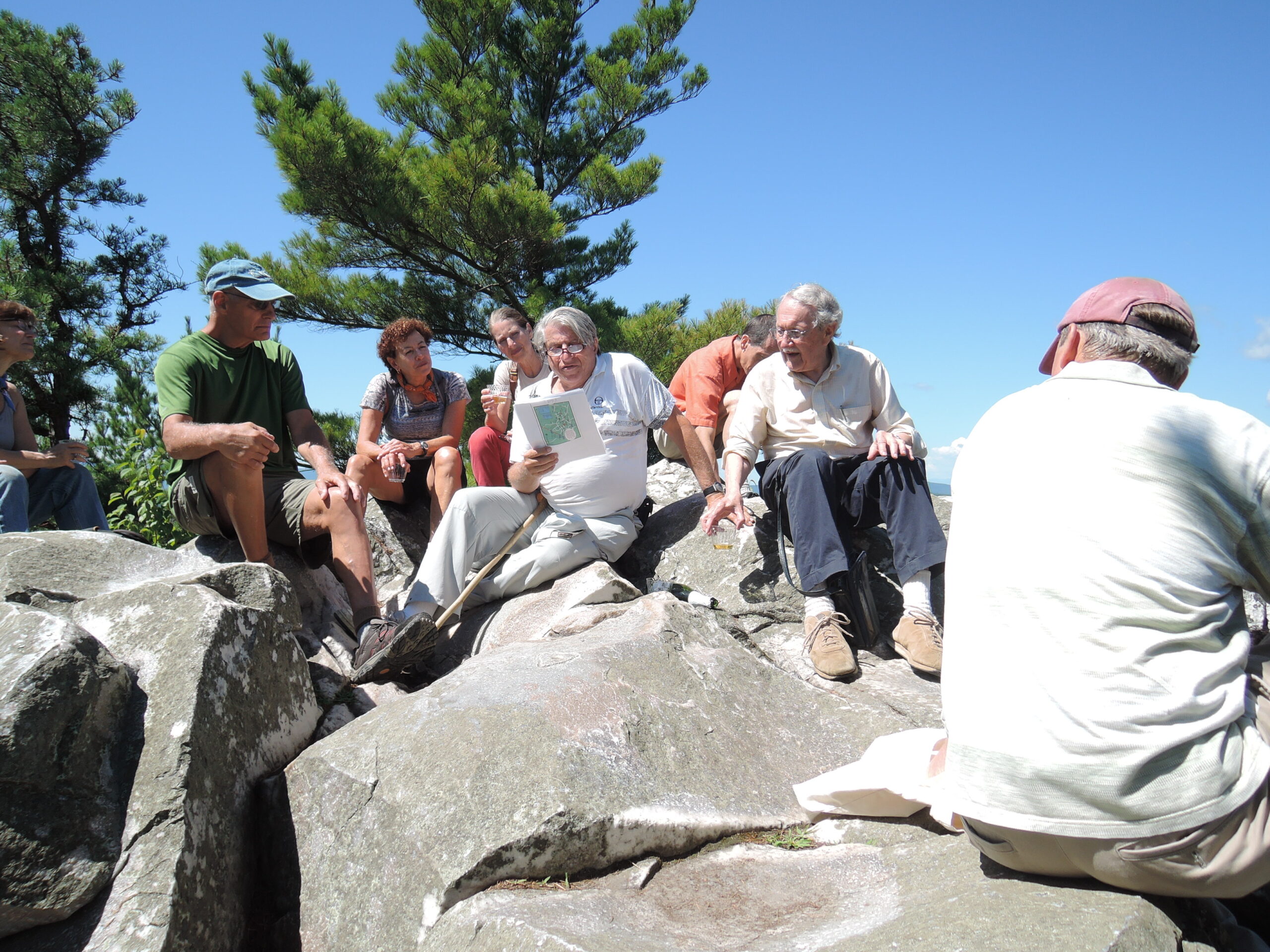
invited to go on a picnic to Monument Mountain,
just south of Pittsfield. Also invited on the
excursion were two other literary notables:
Oliver Wendell Holmes and Nathaniel Hawthorne,
both Berkshire residents. Melville and Hawthorne
met for the first time and struck up an
instantaneous close friendship.
The
impulsive Melville made the decision to follow
Hawthornes example and move permanently to
the Berkshires to find a quiet solitude in which
to write. Melville thought of the beautiful view
of Mount Greylock from the Melvill farm, and
within a week had purchased the neighboring farm
which commanded a similar view. He named the farm
Arrowhead after the native relics he
discovered as he was plowing the fields. The home
would remain his for the next 13 years, and there
he would write some of his finest works.
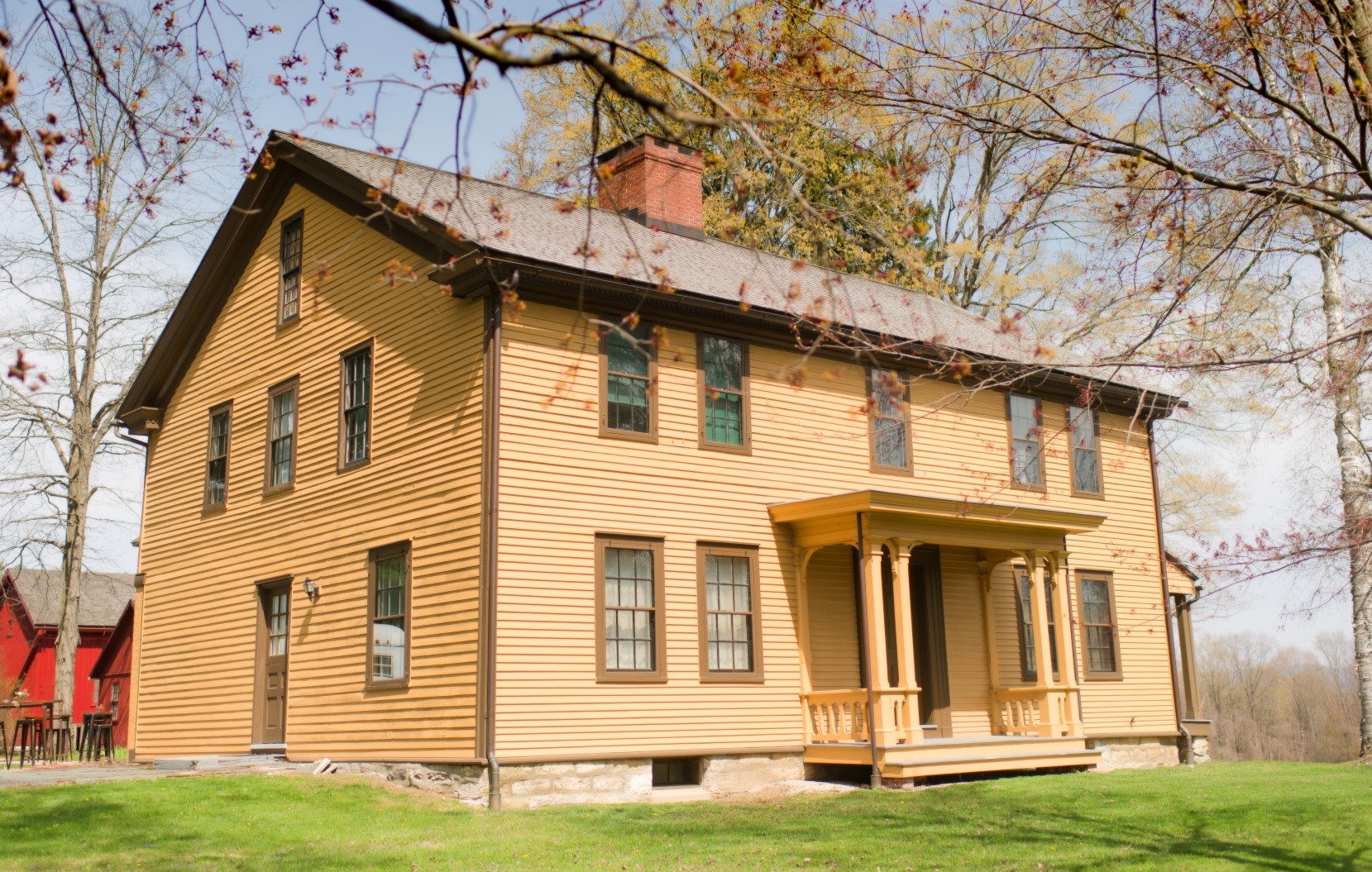
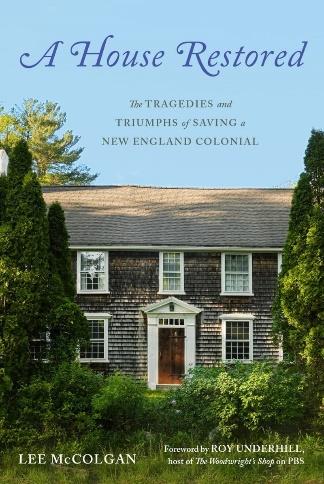
The
house at Arrowhead had been built in 1780. A
rambling old farm house, it became the home for
Herman, Lizzie, Malcolm, and three more children,
all born at Arrowhead: Stanwix, Bessie, and
Fanny. Hermans mother and sisters Augusta,
Helen, and Fanny all moved to Arrowhead as well.
Sister Kate and numerous other friends and
relations would make their home there as well at
various times. It was a busy, chaotic household.
Herman
created a refuge from this chaos in his
second-floor library.
Keeping
to a regular writing schedule, he completed four
novels, a collection of short stories, and 10
magazine pieces, as well as beginning work on a
volume of poetry. The works Melville wrote at
Arrowhead included Moby-Dick, Pierre, The
Confidence-Man, Israel Potter, The Piazza Tales,
and such short stories as I and My
Chimney, Benito Cereno,
Bartleby the Scrivener, and The
Paradise of Bachelors and the Tartarus of
Maids.
Arrowhead
influenced him greatly in his writing. The view
of Mount Greylock from his study window, the one
that brought him to Arrowhead, was said to be his
inspiration for the white whale in Moby-Dick. He
dedicated his next novel, Pierre, to Mount
Greylock. His short story, The
Piazza, begins at Arrowhead and takes a
magical journey to the mountain.
Melville
incorporated features and aspects of Arrowhead
into several stories. The piazza, after which the
story and the book The Piazza Tales were
named, is a porch Melville added to the north
side of Arrowhead shortly after he purchased the
property. Visitors can still stand on that porch
and look at the same view Melville had when he
spent hours there in his rocking chair.
- Now, for a house, so
situated in such a country, to have no
piazza for the convenience of those who
might desire to feast upon the view, and
take their time and ease about it, seemed
as much of an omission as if a
picture-gallery should have no bench; for
what but picture-galleries are the marble
halls of these same limestone
hills?--galleries hung, month after month
anew, with pictures ever fading into
pictures ever fresh.
- Melville in The Piazza.
The story
I and My Chimney, published in Putnams
Monthly Magazine in 1856, contains one of the
most complete descriptions there is of Arrowhead
during the Melville occupancy. The story is a
fictitious account of the efforts of a wife to
remodel an ancient farm house by replacing the
central chimney with a grand hallway. Melville
used Arrowhead as a model for the house, and the
story is filled with accurate descriptions.
- It need hardly be said,
that the walls of my house are entirely
free from fire-places. These all
congregate in the middle--in the one
grand central chimney, upon all four
sides of which are hearths--two tiers of
hearths--so that when, in the various
chambers, my family and guests are
warming themselves of a cold
winters night, just before
retiring, then, though at the time they
may not be thinking so, all their faces
mutually look towards each other, yea,
all their feet point to one centre; and
when they go to sleep in their beds, they
all sleep round one warm chimney[.]
So
proud of this story was Hermans younger
brother Allan, who moved into Arrowhead after his
brother moved out, that he had inscribed on the
chimney itself text from the story. The text
remains for the visitor to see along with an
original copy of the story.
The
beauty which surrounds the property also made its
way into Melvilles works. The novel Israel
Potter is based on the life of a real person
born in Rhode Island. In his novel, however,
Melviille moved Potters birthplace to the
Berkshires and devoted the entire first chapter
to a lyrical description of the area surrounding
Arrowhead. (Visitors can see this same view from
the Nature Trail on the property.)
- In fine clear June days,
the bloom of these mountains is beyond
expression delightful. Last visiting
these heights ere she vanishes, Spring,
like the sunset, flings her sweetest
charms upon them. Each tuft of upland
grass is musked like a bouquet with
perfume. The balmy breeze swings to and
fro like a censer. On one side the eye
follows for the space of an eagles
flight, the serpentine mountain chains,
southward from the great purple dome of
Taconic--the St. Peters of these
hills--northwards to the twin summits of
Saddleback, which is the two-steepled
natural cathedral of Berkshire; while low
down to the west the Housatonic winds on
in her watery labyrinth, through charming
meadows basking in the reflected rays
from the hill-sides.
Melville
lived, farmed, and wrote at Arrowhead for 13
years. But during that time, although he was
writing his best work, he was not making a living
from his writing.
Melvilles family
life was punctuated with moments of joy and with difficulties.
His four children enjoyed the bucolic life in Pittsfield, although
Lizzie had difficulty with her hay fever and frequently took
trips back home to Boston. As much as Melville loved the Berkshires,
he grew frustrated at the lack of success of his writing career
and found his debts mounting. With family pressures to find
gainful employment, and during the disruptions of the Civil
War, Melville decided it was time to move his family from his
beloved farm and return to New York City. There he found work
as a customs inspector at the New York Customs House, a job
he held for over 20 years, working six days a week with only
two weeks of vacation a year. The man who had sailed the world
and written the greatest of American literature now found himself
confined to a desk job that paid four dollars a day.
Melville
sold Arrowhead to his brother Allan who used it
first as a summer home and then moved there
permanently. Melville continued to visit
Arrowhead through the 1880s. The Melville family
owned the house until 1927. In 1975, the
Berkshire County Historical Society purchased the
house and began its restoration.
Melville
stopped writing prose almost entirely for the
rest of his life, turning to poetry and
self-publishing five volumes before his death in
1891. In 1886 he presented Lizzie with a book of
poetry entitled Weeds and Wildings, Chiefly,
with a Rose or Two. Many of the poems were
about happy days at Arrowhead. His final
published work was Billy Budd, the only
prose he had written since 1857; it was not
published until 1924, 33 years after
Melvilles death.

Herman Melville's Arrowhead
780 Holmes Road
Pittsfield MA 01201
Telephone (413) 442-1793
Fax (413) 443-1449
info@mobydick.org
owned and operated by
The Berkshire Historical Society
|